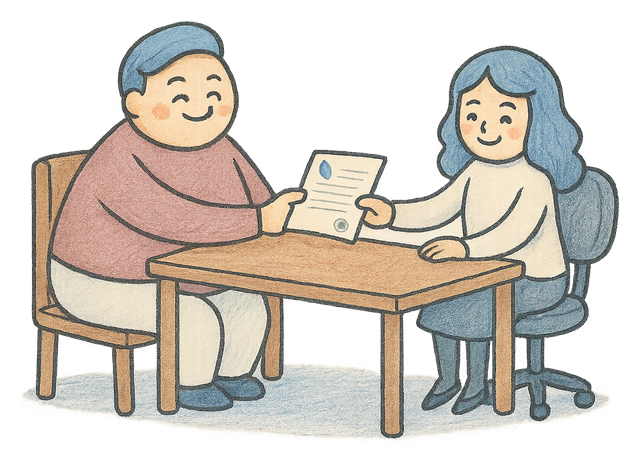

Tell HR, and show them the evidence#
GOV.UK's deed poll guidance sets the terms. A deed poll is the legal document that proves a change of name, a signed one can be used as proof straight away, and each organisation decides which kind it accepts, so you ask. Your employer is no different: its own policy decides what HR needs to see before it changes your record.
The NHS publishes the standard its employers in England work to when they check a new recruit's identity. NHS Employers' identity checks standard says a person may change their name at any time and be known by it, but the change must be matched with documentary evidence that recognises it: a marriage or civil partnership certificate, a decree absolute or dissolution certificate, a deed poll, a Gender Recognition Certificate or a statutory declaration, for example. It also recommends that the record of the checks holds your full legal name alongside any other name you are known by.
If you took a spouse's or civil partner's surname, GOV.UK says you need no deed poll; you send record-holders a copy of the certificate. Whatever the document, it is what links your old name to the new one. Show the original if you can hand it over and take it home again. If HR wants a copy to keep, or asks you to post or upload one, give it a certified copy and keep the original.
Payroll, and telling HMRC yourself#
Once HR has changed your record, payroll carries the new name. Employers report each payment to HMRC in a Full Payment Submission, and GOV.UK's list of what each one must contain includes your title, surname and forenames, spelt correctly and without nicknames or familiar names.
That is not the same as telling HMRC. GOV.UK's payroll guidance says that when an employee's details, such as their surname, change, the employee must tell HMRC straight away and the employer updates its payroll records. You tell HMRC online, after signing in, or in the HMRC app: changing your name with HMRC.
GOV.UK says HMRC changes a tax code when you need to pay a different amount of tax; its examples include claiming Marriage Allowance, but not a change of name. Your National Insurance number remains the same for life.
Payslips, P60 and P45 in the new name#
Your employer must give you a payslip on or before each payday, on paper or electronically, and a P60 by 31 May if you are working for them on 5 April. Both come out of payroll, so once payroll has the new name, they carry it. A payslip in the new name is worth having early, because GOV.UK's passport guidance gives a payslip as an example of evidence that you are using a new name, for a passport in that name.
When you leave, your P45 records your leaving date, your pay and tax for the year so far, your tax code and your personal details. If you start a new job with a P45 in your old name, GOV.UK's P45 guidance for wrong personal details applies: fill in the starter checklist, give it to your new employer with the P45 so it can correct your details, and tell HMRC.
Tell your pension scheme#
A pension scheme keeps its own record of you, and schemes update it in different ways.
- NHS Pensions asks members to keep their personal details, their name among them, up to date with their employer. Members not currently employed by the NHS contact NHS Pensions instead.
- Nest lets an employer change a worker's name only until the worker has logged in to their Nest account. After that you change it yourself, under "Edit personal details" in your online account. Nest says it may ask for evidence, updates your details within five working days of receiving it, and returns original evidence the same way you sent it.
Schemes from earlier jobs need telling too, each through its own process: pensions, savings and investments lists the main ones.
Right to work checks when names differ#
An employer checks your right to work before you start, and your name matters to the check only when the documents you show are in different names.
British and Irish citizens. GOV.UK says a British or Irish passport, current or expired, proves your right to work. Without one, you show a UK or Irish birth or adoption certificate, or a certificate of registration or naturalisation as a British citizen, with an official letter or document from a government agency or a previous employer showing your name and National Insurance number. A passport or birth certificate in your old name next to a letter in your new one is a difference in names, and the Home Office's guide tells employers to check the reason with evidence such as a marriage certificate, a divorce decree absolute or a deed poll.
What the employer keeps depends on the date. The guide in force until 30 September 2026 says those supporting documents "must also be photocopied, and a copy retained". The version in force from 1 October 2026 says employers "may choose to retain copies" to show they made the check. Under both, copies of right to work documents are kept for as long as you work there and for two years afterwards.
eVisa holders. An online check uses a share code, and GOV.UK says that if you have changed your name you should update your UKVI account before you get one, so that the details are right. You need an identity document that proves the change, and you cannot change the name while you are waiting for a visa decision. From 1 October 2026 the guide tells an employer whose online check shows a different name from the one you gave to advise you to update your Home Office account. Changing your name if you are not a British citizen explains the order the Home Office expects.
Registers, certificates and DBS checks#
If your job depends on a professional registration, you change your name on the register with the regulator, separately from HR: professional regulators sets out how each one does it. NHS Employers' standard for registration and qualification checks notes that the name on a qualification certificate may not match the one you now use, after marriage, civil partnership or divorce for example, and requires employers in that case to obtain additional evidence of the change of name. Exam and degree certificates covers reissues, and DBS checks covers previous names on a criminal record check.
If you are transitioning#
Acas's guidance for employers says records showing an employee's previous name, title or pronouns must be kept confidential, and that employer and employee should agree how and when records and systems change, from the work email account to security passes and photo ID. GOV.UK tells an employer updating both name and gender to report them in separate payroll submissions, because otherwise HMRC may create duplicate records. Who can see my former name? covers DBS checks, right to work checks and the legal protection a Gender Recognition Certificate brings.
Questions people ask
Can I use my new name at work straight away?
Yes. GOV.UK says you can use a signed deed poll as proof of your new name straight away. Your employer's records change once HR has seen the evidence it asks for. When can I use my new name?
Does changing my name mean a new right to work check?
The Home Office guide asks for a check before you start and, if your permission to work in the UK is time-limited, a follow-up check on or before the date it ends. A List A document such as a British passport, checked correctly at the start, covers your employer for as long as you work there. If you have an eVisa, put the new name on your UKVI account before your next check.
My passport is still in my old name. Can I start a new job?
Yes. GOV.UK says a British or Irish passport proves your right to work whether it is current or expired. The difference from the name you now use is explained by the deed poll or certificate that changed it, so take that to the check as well.
What if HR insists on an enrolled deed poll?
GOV.UK says some organisations may only accept an enrolled deed poll and tells you to check with them. The Home Office's own examples of evidence for a right to work check say simply "deed poll", and NHS Employers' identity standard lists a deed poll without asking for enrolment. Ask for the policy in writing: if an organisation refuses your deed poll.
Something else? Ask us, and a person replies by email, normally the same working day.