
Who issues a deed poll certificate?#
Nobody. A deed poll is a document you make yourself or have drafted, and GOV.UK says a signed deed poll can be used as proof of the new name at once. No office checks it, numbers it or sends back a certificate. HM Passport Office's guidance describes an unenrolled deed poll as one no court has endorsed, which is almost every deed poll. A deed made the same way is used in Scotland and Northern Ireland too.
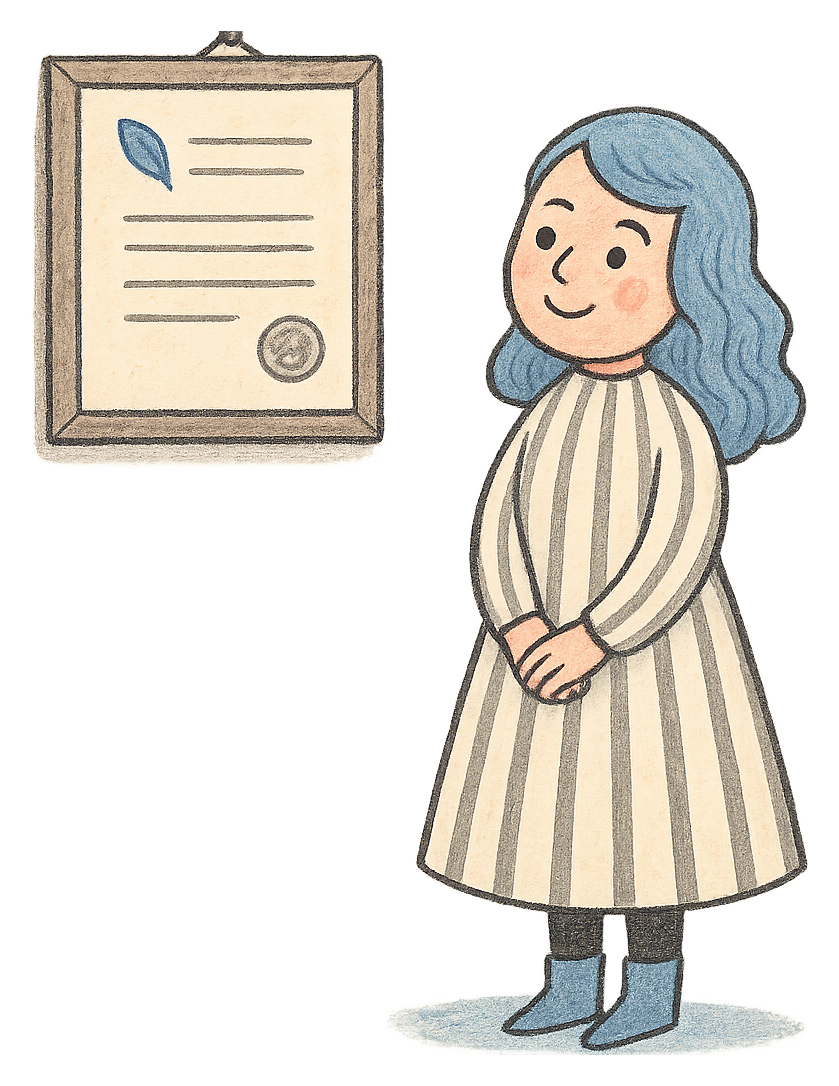
So "deed poll certificate" describes how the document looks rather than where it comes from. It is a formal document of declarations, signatures and witness details, and organisations are used to seeing it on certificate paper, which is how ours is printed. When a bank, an employer or a form asks for your deed poll certificate, or your change of name certificate, it means the deed poll.
What does a deed poll certificate look like?#
There is no official design. HM Passport Office tells its staff that an unenrolled deed poll has no set format or wording and can be drawn up by the person changing their name. A deed that follows the wording GOV.UK publishes has five parts:
- The declaration. Your old name, your address, and the statement that you have given up the old name and adopted the new one for all purposes.
- Two acknowledgements. That you have told the police where the law requires it, and that authorities issuing documents in the new name, such as a passport, may check the history of both names.
- The execution clause. A line saying it is signed as a deed, on a stated date, in both names, in the presence of the witnesses it names.
- Your signatures, one in your new name and one in your old name.
- The witnesses. Each witness's name, address and signature. GOV.UK asks for two, aged 18 or over; our deeds have space for two and we recommend both.
HM Passport Office tells its staff to ask for a new deed if it is not signed in both names, not witnessed, not signed in wet ink, not dated, or open to doubt about whether it is genuine. A seal, a stamp, a reference number and a solicitor's signature are not on that list, and the guidance says the witness need not be a solicitor.
What does an enrolled deed poll look like?#
Different, because it is made on the court's own form. Enrolment puts a change of name on public record with the High Court, and an adult's deed is form LOC020, headed as a change of name deed for enrolling in the Senior Courts of England and Wales. Its wording is older and more formal, it records your citizenship and marital status, and its two witnesses give an occupation as well as an address. GOV.UK says that once the application is approved, the Deed Poll Office seals the deed and posts it back as proof of the change, and a notice with your new name and your address appears in The Gazette.
That sealed deed is the only version of a deed poll that comes back from an official body, and The National Archives estimates that fewer than 1% of changes of name by deed poll are enrolled. Enrolment is optional, costs £53.05 and, by GOV.UK's account, may take several months. Enrolled and unenrolled deed polls compares the two.
Is there a deed poll certificate in Scotland?#
A deed poll works in Scotland as it does in the rest of the UK, and the deed is still the document. What Scotland adds is a record. If your birth or adoption was registered there, National Records of Scotland can note the change on that entry, after which every newly issued birth or adoption certificate carries both names, current and former. NRS charges £40, plus £10 for each additional family member applying at the same time. The service is not for changes made on marriage, divorce or civil partnership, and NRS does not send a new certificate automatically; it explains how to order one once the change is recorded.
The record is optional, and HM Passport Office's guidance tells its staff to accept a Scottish birth certificate showing both names as evidence of the change. Changing your name in Scotland covers the rest.
What about Northern Ireland?#
GRONI, the General Register Office for Northern Ireland, offers the same kind of record for a forename or surname where the birth was registered there. The application is signed in the presence of a solicitor, a lay magistrate or a justice of the peace; nidirect puts the fee at £35 for recording the change, with £15 extra for a certificate that shows it, and GRONI's form says your birth certificate will then carry the changed name. A deed poll remains open to you in Northern Ireland too, and nidirect names it alongside the GRONI record.
In both places that new birth certificate is the nearest thing to an official change of name certificate, and in both it is optional.
What do I send when someone asks for my certificate?#
Your deed poll, in the form that organisation takes. HM Passport Office's guidance asks for an original or a replacement document as evidence of a change of name, and DVLA asks for original documents and says not to send photocopies. Most other organisations are content with a certified copy, which they keep on file, so the original stays at home.
If a member of staff says the deed is not the certificate they mean, ask which document they have in mind. In England and Wales no other deed poll document exists, and what to do if an organisation refuses your deed poll has the steps that settle it.
How do I get a copy or a replacement?#
- A certified copy. No office keeps a copy of an unenrolled deed, so a certified copy has to be made from the original. We certify copies of the deeds we draft.
- A replacement. If the original is lost, damaged or unreadable, a replacement deed poll records the change you already made and when you made it, signed and witnessed like any deed. I have lost my deed poll covers where to look first.
- A copy of an enrolled deed. The court keeps a photocopy of each deed it enrols, and older enrolments are held by The National Archives: how to find a record of a name change.
To see which document your own change needs, try certificate, deed poll or court order?
Questions people ask
How do I get a deed poll certificate?
By making a deed poll. You can write one yourself from the wording GOV.UK publishes, or have it drafted: ours is £18.50, a paralegal drafts and checks it, it is printed on certificate paper, and it goes in the post the same working day. GOV.UK says it works as proof as soon as it is signed; nothing is sent anywhere afterwards.
Is a change of name deed the same as a deed poll?
Yes. HM Passport Office's guidance to its staff says an unenrolled deed poll and a change of name deed are the same thing, and applies the same test to both.
Can I laminate my deed poll?
Better not. DVLA asks you not to send laminated certificates, and HM Passport Office's guidance says it does not accept laminated evidence of a change of name, except a change of name deed or a marriage or civil partnership certificate sent with a change of name passport application.
Something else? Ask us, and a person replies by email, normally the same working day.