Deed#
A deed is the older and more formal kind of legal document. Where a contract needs two sides and something given in exchange, a deed binds the person who makes it simply because of how it is made: written, signed and witnessed, and delivered as a deed. That is why a change of name works as a deed and not as a contract. Nobody is on the other side of it. You alone declare that you have given up one name and taken another, and the witnessing is what gives the declaration its force. The National Archives puts it in a sentence: a deed poll is a legal contract involving only one party.
Poll#
"Poll" is the old part. The Online Etymology Dictionary traces the sense in "deed poll", a deed executed by one party only, to the verb meaning to cut the hair of, because such a deed was cut straight rather than indented. The same word survives in "polled" cattle, animals whose horns have been removed, and in "pollarded" trees, cut back level.
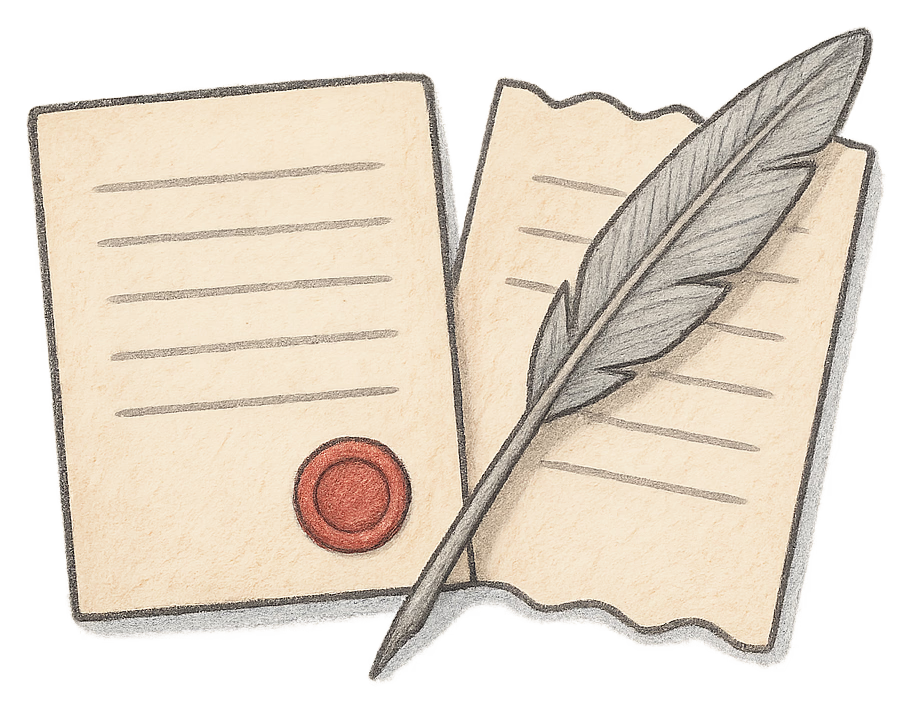
The contrast is with the indenture. When a deed had two or more parties, the clerk wrote it out twice on one sheet of parchment and cut the copies apart along a wavy or notched line, so that each party's copy had a jagged edge that fitted the other's. Fitting the two halves together proved that the copies were genuine. A deed with one party needed no matching half, so its edge was cut clean. It was polled. The name of the document is a description of its edge.
Change of name deed#
You will also see the same document called a change of name deed, and some organisations use that phrase. There is no difference. HM Passport Office's guidance to its staff says in terms that unenrolled deed polls and change of name deeds are the same thing, and it treats both the same way: signed in both names, at least one witness, wet signatures, dated.
Enrolled#
Since a deed poll is made by one person and kept by that person, there is usually no copy anywhere else. The National Archives notes that if a deed poll was drawn up without a solicitor, there may never have been any record of it other than the document itself. A person who wants a public record can enrol the deed at the High Court, into what were once the Close Rolls of Chancery and are now the Enrolment Books of the Supreme Court of Judicature, with a notice in The Gazette; that has been the arrangement for enrolled changes since 1914. The archives estimate that fewer than 1% of deed polls are enrolled. The rest are what the word says: one person's deed, cut clean, kept at home.