What is the court deciding?#
If those with parental responsibility disagree about a child's name, the question can go to the family court. GOV.UK names two orders for disagreements like this: a specific issue order, which settles one disputed question, and a prohibited steps order, which stops a particular step being taken without the court's consent. Whichever is asked for, GOV.UK says, the judge's decision turns on the child's best interests. Specific issue orders covers the application itself.
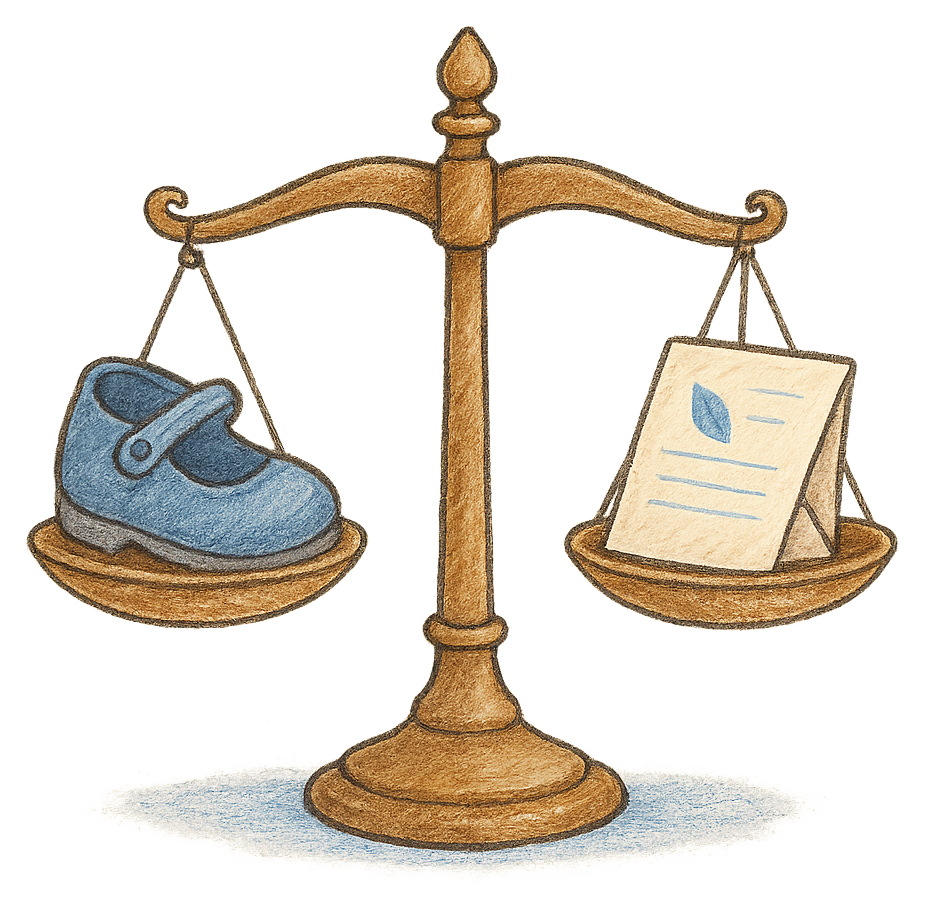
The question is not which parent is right. It is whether a new name, or the name the child already has, is better for the child. And the approach is the same for a first name as for a surname: the Court of Appeal said in 2024 that this is now settled law.
What does the law tell the judge to put first?#
The starting point is section 1 of the Children Act 1989: when a court decides any question about a child's upbringing, the child's welfare is its paramount consideration. The Act also tells the court that delay is likely to harm the child, and that it should make an order only if doing so would be better for the child than making none.
When one side opposes the order, the judge must have regard in particular to the welfare checklist in section 1(3):
- the child's ascertainable wishes and feelings, in the light of their age and understanding;
- their physical, emotional and educational needs;
- the likely effect on them of any change in their circumstances;
- their age, sex, background and any relevant characteristics;
- any harm they have suffered or are at risk of suffering;
- how capable each parent, and anyone else relevant, is of meeting their needs;
- the range of powers the court has.
What do the leading judgments say about surnames?#
The leading case is Dawson v Wearmouth, decided by the House of Lords in 1999, which the Court of Appeal called "the lodestar" for any application to change a child's surname. In the passage the Court of Appeal quoted, Lord Jauncey said that changing a child's surname "is a matter of importance", that the court must first and foremost look to the child's welfare, and that it must weigh what is likely to affect the child in the future as well as the present.
The Court of Appeal built on it in Re W, Re A, Re B (Change of Name), also in 1999. As the High Court summarised that guidance in 2017:
- The surname the child was registered with, and the reason for it, such as recognising the link with the father, is always relevant and important, but it does not decide the case on its own.
- Factors that may arise in the future count as well as the present situation.
- Reasons based on the child's name matching, or not matching, that of the parent applying do "not generally carry much weight".
- The reasons for any earlier change that one parent made alone may be relevant, and so may changes in the child's life since the birth was registered.
- Where the parents were married and the child was registered with the father's surname, there would have to be strong reasons to change it.
- Where they were not married, the father's commitment to the child, the quality of any contact and whether he has parental responsibility are all relevant.
The High Court, citing Dawson v Wearmouth, added in 2023 that the parents' own views matter only in so far as they may affect how each parent behaves, and so, indirectly, the child's welfare.
Why is a change treated as a serious step?#
Because a name ties a child to a family and to an identity. "A surname defines, and is defined by, familial heritage and genealogy", Mr Justice Cobb said in 2017, and in 2024 Mr Justice Poole called a change of a child's forename or surname "a serious decision whatever the age of the child".
Serious does not mean impossible. In 2017 the High Court let a mother give two children new forenames and surnames, kept secret from a father who had abducted them abroad; the judge described the orders as exceptional but necessary and proportionate for the family's safety. The Court of Appeal's reminder is that each case "will turn on its own particular facts".
How much do the child's own wishes count?#
They head the checklist, and how much weight they carry depends on the child's age and understanding. The court can ask a family court adviser from Cafcass, or from Cafcass Cymru in Wales, to report, and the adviser may talk to the child about how they feel. Cafcass tells parents the court pays particular attention to a child's wishes and feelings but may not always do what the child wants.
In 2024 the High Court allowed a 15-year-old in foster care to change both her names, to break their link with a father the family court had found had abused her, giving "considerable weight" to her settled wishes. The same year the Court of Appeal said that 16 and 17 year olds are presumed able to decide to change their names, and that their wishes and feelings, "whilst not determinative, are a powerful factor in the welfare analysis". Does a child have to agree to their own name change? explains how children are heard.
What does this mean if you are applying, or responding?#
- Try to agree first. GOV.UK expects an attempt at agreement before any application, and a mediator accredited by the Family Mediation Council can help.
- Talk about the child, not the other parent. The court asks what a change would do for the child, now and as they grow up.
- Take advice. Citizens Advice, a family solicitor, or legal aid if you qualify.
Everything above is the law of England and Wales. In Scotland, the Children (Scotland) Act 1995 also makes the child's welfare paramount, and requires the court, taking account of the child's age and maturity, to give the child a chance to express views and to have regard to them.
Questions people ask
What are valid reasons to change a child's surname?
The law has no list. The question is always whether the change is in the child's best interests. Reasons about the child, such as their safety or their own settled wish, have persuaded courts; a wish for the child's surname to match the applying parent's does not generally carry much weight on its own.
Does it help that my child already uses the new name?
It can be relevant but does not settle it. The Court of Appeal's guidance says the reasons for an earlier change made by one parent alone may be relevant, so the court looks at how the new name came to be used. Where a young person has chosen a name themselves, time counts: in 2024 the Court of Appeal called three years "a very long time in the life of a 15 year old".
Will the judge talk to my child?
A child does not have to meet the judge. Cafcass tells children they can write to the judge or ask to meet them, and the judge decides whether a meeting happens. Does a child have to agree to their own name change? explains how children are heard.
Something else? Ask us, and a person replies by email, normally the same working day.