Who can witness a deed poll#
Any independent adult who knows you. In practice a good witness is:
- aged 18 or over on the day they sign, which GOV.UK's wording requires;
- independent of you: not your husband, wife or partner, not a relative by blood or marriage, and not someone who lives at your address;
- someone who knows you well enough to know you by your old name;
- living in the UK, if you are.
A friend, a neighbour or someone you work with is the usual answer, and none of them carries less weight than a professional. A solicitor can witness a deed poll, but is not needed: GOV.UK describes making the deed yourself in front of two witnesses, and says nothing about a solicitor being required.
Who cannot#
GOV.UK's warning is specific: some organisations will not accept a deed poll if a witness lives at the same address as you or is a close relative. Since the point of a witness is to be someone with no stake in your name change, treat the following as ruled out:
- your husband, wife or partner, because they are not independent of you;
- a parent, child, brother or sister, and any other relative, however well they know you;
- an in-law, because related by marriage still counts as related;
- anyone living at your address, even a lodger or a housemate who is not related to you;
- anyone under 18 on the day;
- you. Nobody can witness their own deed.
A married couple cannot both witness your deed either: each is ruled out on their own account if they are related to you, and if they are not, two witnesses from one household is exactly the arrangement a bank clerk looks twice at. Two people from two households is the safe choice.
One witness or two?#
The law requires one. Section 1 of the Law of Property (Miscellaneous Provisions) Act 1989 says a deed made by an individual must be signed in the presence of a witness who attests the signature. GOV.UK's wording for a home-made deed poll names two witnesses, our deeds have space for two, and we recommend using both, because two is what organisations expect to see. If you have already signed in front of one independent adult, the deed is valid; if you have not signed yet, use two.
What HM Passport Office checks#
Its guidance to its own staff spells out the test an unenrolled deed poll has to pass: signed in the old and new names, signed by at least one witness, who does not need to be a solicitor or a commissioner for oaths, every signature in wet ink rather than electronic, and dated. A deed that meets that test is accepted, including one made online. Two independent witnesses, one pen and the day's date meet it with room to spare.
The order to sign in#
Everything happens in one sitting, with both witnesses in the room.
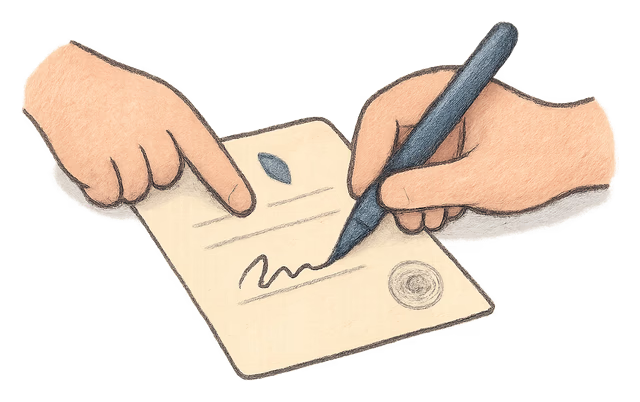
- Sign in your old name. The signature you have been using until now, in the space for your old name.
- Sign in your new name. The signature you will use from now on. If your signature is an unreadable scrawl the two may look the same, and that is fine; you do not have to change how you sign.
- Date it. With the date you are actually signing, never in advance. The date on the deed is the date your name changed.
- Your witnesses sign. Each watches you sign, then signs in their own space and writes their full name, address and occupation underneath.
If anything else in the envelope has signature lines, such as certified copies, sign it at the same sitting in the same way, so every document carries the same signatures and the same date.
What your witnesses are confirming#
Only that they watched you sign. They are not vouching for the name you have chosen, checking your identity, or taking on any responsibility for what you do with the deed. That is why a friend is as good as a solicitor, and why the one thing a witness must not do is sign a deed they did not see signed.
Four habits that keep a deed clean#
Each removes a reason for somebody to look twice at the document.
- One pen, one sitting. Use the same pen, in black or blue ink, for every signature on the same occasion. The deed then plainly shows it was signed at one time.
- Witnesses in the room. They cannot watch you sign over a video call, and they cannot sign it later that evening.
- Date it on the day. Filling in Tuesday's date and signing on Thursday puts a false date on a legal document.
- No corrections. No correction fluid, no crossing out, no writing over a letter, no initials in the margin. An altered deed is the easiest of all to question, because nobody can tell what it said before.
If you spot a mistake in the names or the wording before signing, stop and have the deed redrafted. If you have already signed a deed with a mistake in it, do not send it anywhere; the fix is a correctly drafted deed, signed and witnessed again.
What happens the moment it is signed#
Your name is your new name. Not when a bank accepts it, and not when the new passport arrives: the change takes effect when you and your witnesses have signed and dated the deed, and GOV.UK says you can use it straight away as proof.
Nothing is sent back to whoever drafted it and nothing is filed anywhere. There is no register of unenrolled deed polls and nobody else holds a copy, so keep the original flat and dry, and let certified copies do the travelling. After that it is a paperwork job rather than a legal one: who to tell, and in what order.
Signing a child's deed poll#
A child under 16 does not sign. The parent who applied signs on the child's behalf, in front of two witnesses, in exactly the same way, and the deed records that everyone with parental responsibility agrees. A young person of 16 or 17 signs their own deed.